

Pakistan History, Language and Culture
History of Pakistan
The region that is now Pakistan has been a crossroads of civilisations for millennia. It was once part of the Achaemenid Empire (6th–4th century BCE), serving as a vital link in the Persian Empire's trade and governance. In the centuries that followed, it witnessed the conquests of Alexander the Great (4th century BCE), the rise of the Mauryan Empire, and the flourishing of the Indo-Greek, Kushan, and Gupta empires. These periods brought influences of Buddhism, Hinduism, and Hellenistic culture, leaving enduring legacies in art and architecture.
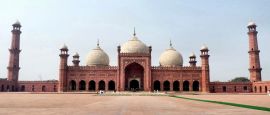
The Mughal Empire (16th–18th century) ushered in a golden era marked by grand architecture, cultural innovation, and thriving trade. Monuments like the Lahore Fort and Badshahi Mosque stand as testaments to this legacy. In the mid-19th century, the British East India Company annexed the region, and it became part of British India, introducing modern infrastructure, education, and legal systems.
In 1947, Pakistan gained independence on 14 August following the Partition of British India, becoming a separate state for Muslims under the leadership of Muhammad Ali Jinnah. Initially comprising West Pakistan (modern-day Pakistan) and East Pakistan (modern-day Bangladesh), the country faced significant challenges in uniting its geographically and culturally distinct regions. In 1971, after a civil war and intervention by India, East Pakistan seceded to become Bangladesh.
Since then, Pakistan has navigated periods of political instability, military rule, and economic challenges while asserting itself as a resilient nation with a rich cultural heritage and a strategic role on the global stage.
Did you know?
• The name Pakistan translates to 'land of the pure' in Persian and Urdu.
• Pakistan is home to the highest paved road in the world. At an elevation of 4,693m (15,397ft) above sea level, the Karakoram Highway connects Pakistan with China.
• Pakistan hosts the world's largest volunteer ambulance service, founded by Abdul Sattar Edhi, a humanitarian who established the Edhi Foundation to provide emergency medical care and social services.
Language in Pakistan
Urdu is the national language of Pakistan and is widely understood across the country, serving as a common means of communication between different regions. English is also widely used in business, government, and tourism.
Pakistan is linguistically diverse, with regional languages including Punjabi, Sindhi, Pashto, and Balochi. Punjabi is the most widely spoken language, particularly in the Punjab province, while Pashto is common in Khyber Pakhtunkhwa and Balochi in Balochistan.
Urdu is closely related to Hindi, and the two are largely mutually intelligible in spoken form, though they are written in different scripts. In everyday interactions, many Pakistanis are multilingual and switch easily between languages.



 You know where