

Casablanca is Morocco's largest city and principal commercial centre. The immense Hassan II Mosque rises beside the Atlantic and has an elaborately decorated interior open to non-Muslims on guided tours. Elsewhere, the city centre retains numerous Art Deco buildings, while the palm-lined streets and arcades of the Habous Quarter offer a more orderly interpretation of a traditional medina.
Book and Go

Latest features
Morocco things to see and do
Casablanca
Fez (Fes)
Fez el-Bali is a dense labyrinth of lanes, markets, mosques and workshops where many traditional crafts are still practised by hand. Its principal monuments include the Bou Inania Madrasa, Al Quaraouiyine Mosque and University, and the monumental gates of the Royal Palace. The city's tanneries are best viewed from the terraces of surrounding leather shops.
Tangier
Overlooking the Strait of Gibraltar, Tangier has long served as a meeting point between Africa and Europe. Its medina climbs towards a hilltop kasbah containing the Kasbah Museum, while the American Legation records the long diplomatic relationship between Morocco and the United States. West of the city, Cap Spartel and the Caves of Hercules face the meeting of the Atlantic Ocean and Mediterranean Sea.
Agadir and Taghazout
Modern Agadir was largely rebuilt after the devastating earthquake of 1960 and is now centred on a broad sandy beach, seafront promenade and marina. The surviving walls of the hilltop Agadir Oufella provide panoramic views over the city and bay. North along the coast, the former fishing village of Taghazout has developed into Morocco's best-known surfing centre.
Aït Benhaddou and Ouarzazate
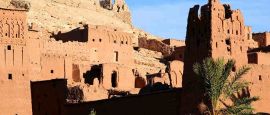
Aït Benhaddou is a fortified earthen settlement whose clustered towers rise above the former caravan route between the Sahara and Marrakech. Its UNESCO-listed ksar has appeared in numerous films and television productions. Nearby Ouarzazate is home to film studios and the imposing Taourirt Kasbah, once associated with the powerful Glaoui family.
Chefchaouen
Chefchaouen lies beneath the peaks of the Rif Mountains, its compact medina distinguished by lanes, steps and courtyards painted in shades of blue. Plaza Uta el-Hammam is overlooked by the town's red-walled kasbah, while paths beside the Ras el-Maa spring lead towards viewpoints above the rooftops. The surrounding mountains offer walks through forest, farmland and limestone scenery.
Dadès Valley and Todra Gorge
The Dadès Valley follows a ribbon of palms, cultivated fields and fortified villages between vividly coloured rock formations. A winding road climbs above the narrowest section of the Dadès Gorge, revealing striking views across the valley. Farther east, the sheer limestone walls of Todra Gorge narrow dramatically around a riverbed popular with walkers and rock climbers.
Essaouira
Stone ramparts, whitewashed houses and blue fishing boats give Essaouira a distinctive character on Morocco's Atlantic coast. The Skala de la Ville offers views along the fortified seafront, while the harbour remains active with fishing vessels and seafood stalls. Strong coastal winds attract windsurfers and kitesurfers, and the city is also closely associated with Morocco's Gnaoua musical tradition.
High Atlas Mountains and Imlil
The High Atlas Mountains contain deep valleys, terraced fields and Amazigh villages built against steep slopes. Imlil is the main starting point for walks in Toubkal National Park and ascents of Jebel Toubkal, the highest mountain in North Africa. Routes range from village walks and mule-supported treks to demanding multi-day climbs.
Marrakech (Marrakesh)
Within Marrakech's rose-coloured walls, narrow lanes lead through crowded souks to palaces, gardens and richly decorated religious schools. Jemaa el-Fna fills with food stalls, musicians and storytellers towards evening, while nearby landmarks include the Koutoubia Mosque, Bahia Palace and Saadian Tombs. Beyond the medina, Jardin Majorelle and the adjacent Pierre Bergé Museum of Berber Arts provide a quieter contrast.
Meknes and Volubilis
Meknes was transformed into an imperial capital by Sultan Moulay Ismail during the 17th century. Its monumental heritage includes Bab Mansour, the vast former royal granaries and stables of Heri es-Souani, and the Mausoleum of Moulay Ismail. Nearby Volubilis contains Morocco's most extensive Roman ruins, with triumphal arches, columns and mosaic floors spread across a fertile hillside.
Merzouga and Erg Chebbi
The village of Merzouga stands beside Erg Chebbi, a sweeping field of Saharan dunes that change colour with the movement of the sun. Camel and four-wheel-drive excursions cross the sand to desert camps, where visitors can watch the sunset and spend the night beyond the village lights. The nearby seasonal lake of Dayet Srij attracts migratory birds when it contains water.
Ouzoud Falls
Water tumbles in several stages through a red-rock gorge at Ouzoud, surrounded by olive groves and wooded slopes. Paths descend from the village to viewpoints and pools below the falls, with small boats operating near the base when conditions permit. Barbary macaques inhabit the surrounding area, although visitors should avoid feeding or approaching them.
Rabat
Morocco's capital combines monumental architecture with a relatively relaxed Atlantic setting. The 12th-century Hassan Tower stands beside the marble Mausoleum of Mohammed V, while the Kasbah of the Udayas contains white-and-blue lanes overlooking the mouth of the Bouregreg River. The fortified archaeological site of Chellah preserves Roman remains and the ruins of a medieval Islamic necropolis.
Tétouan
Tétouan's UNESCO-listed medina reflects the city's close historical links with Andalusia. Whitewashed houses, tiled courtyards and craft workshops fill the old quarter, which remains enclosed by sections of its original walls. The Archaeological Museum and the Centre of Modern Art provide further insight into the region's Roman, Islamic and Spanish-influenced heritage.
Do you have any Feedback about this page?
© 2026 Columbus Travel Media Ltd. All rights reserved. No part of this site may be reproduced without our written permission, click here for information on Columbus Content Solutions.



 You know where
