
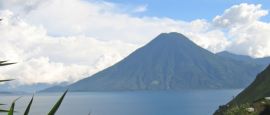


The overnight ascent of Acatenango is one of Guatemala's most demanding and memorable hikes. Campsites high on the volcano provide views towards neighbouring Volcán de Fuego, which frequently sends ash and glowing material into the sky. The altitude, cold and steep terrain make a reputable guide and suitable equipment essential.
Book and Go

Latest features
Guatemala things to see and do
Acatenango Volcano
Antigua Guatemala
Pastel-coloured houses, cobbled streets and ruined churches lie beneath a dramatic ring of volcanoes in Guatemala's former colonial capital. The Santa Catalina Arch is its best-known landmark, but the courtyards, convent ruins and richly decorated façade of La Merced reveal much more of Antigua's character. The city is a UNESCO World Heritage Site.
Archaeological Park and Ruins of Quiriguá
Quiriguá is celebrated for its exceptionally tall carved stelae, monumental stone slabs recording Maya rulers, dates and political events. Intricately sculpted zoomorphs, massive stones shaped into mythical creatures, stand around the Great Plaza. The compact UNESCO-listed site lies amid tropical lowlands close to the road between Guatemala City and the Caribbean coast.
Chichicastenango
Chichicastenango's famous market fills the streets with fruit, vegetables, textiles, pottery, flowers and household goods, particularly on Thursdays and Sundays. On the steps of the whitewashed Church of Santo Tomás, Catholic observance mingles with longstanding K'iche' Maya traditions as worshippers burn incense and make offerings.
El Mirador
Hidden deep within the Maya Biosphere Reserve, El Mirador was one of the largest cities of the early Maya world. Its immense La Danta complex rises above dense tropical forest, but reaching it normally requires a demanding guided trek lasting several days or a helicopter flight. The isolation is central to the experience and visits require careful planning.
Flores
Colourful houses and restaurants crowd the small island of Flores on Lake Petén Itzá, connected to the mainland by a short causeway. Its waterfront promenade, narrow streets and lake views make it an appealing base for visiting Tikal and the other archaeological sites of northern Guatemala.
Guatemala City
Guatemala's sprawling capital rewards visitors who look beyond its busy avenues. The historic centre contains the imposing National Palace of Culture, Metropolitan Cathedral and bustling Central Market, while the Museo Ixchel del Traje Indígena and Museo Popol Vuh house outstanding collections of Maya textiles, ceramics and archaeological artefacts.
Iximché
Iximché was the capital of the Kaqchikel Maya when the Spanish arrived in the early 16th century and briefly became the first colonial capital of Guatemala. Its plazas, temples and ballcourts occupy a forested plateau near Tecpán, and Maya ceremonies are still performed at sacred areas around the ruins.
Lake Atitlán
Three volcanoes frame the deep-blue waters of Lake Atitlán, with Maya communities scattered along its steep shores. Public boats connect Panajachel with villages including San Juan La Laguna, known for weaving and community art projects; Santiago Atitlán, a centre of Tz'utujil Maya culture; and San Marcos La Laguna, known for retreats and wellness activities.
Monterrico
Monterrico is known for its broad beach of volcanic black sand and powerful Pacific surf. Behind the coast, the mangroves and waterways of the Monterrico-Hawaii reserve can be visited by small boat, particularly in the early morning when herons, kingfishers and other waterbirds are active. Sea turtles nest along this coast during parts of the year.
Pacaya Volcano
Pacaya is one of Guatemala's most accessible active volcanoes and can be visited on guided walks from Antigua or Guatemala City. Trails cross dark volcanic slopes with wide views over neighbouring peaks, although the route and what can be seen depend on current volcanic activity. Access restrictions must be followed.
Quetzaltenango (Xela)
Commonly called Xela, Guatemala's second-largest city has an elegant central square surrounded by neoclassical buildings and a strong highland identity. It is a useful base for visiting Maya villages, walking in the surrounding mountains and bathing in the naturally heated pools of Fuentes Georginas.
Río Dulce and Livingston
The Río Dulce flows from Lake Izabal through a gorge of forested cliffs before reaching the Caribbean. Boat journeys pass mangroves, waterbirds and riverside hot springs on the way to Livingston, a coastal town shaped by Garifuna, Maya and Afro-Caribbean culture. Livingston has no road connection and is reached by boat.
Semuc Champey
A limestone bridge spans the Río Cahabón at Semuc Champey, where a chain of turquoise pools forms beneath the forest. Visitors can swim in the pools and climb to the El Mirador viewpoint for the classic view of the cascading water. The final road from Lanquín is rough, reinforcing the sense of remoteness.
Tikal National Park
Great stone temples rise above the rainforest canopy at one of the most powerful cities of the ancient Maya world. Trails lead between ceremonial plazas, palaces and pyramids while howler monkeys, toucans and coatis move through the surrounding forest. From the top of structures open to visitors, the temples can be seen rising above an immense expanse of rainforest.
Yaxhá-Nakum-Naranjo National Park
Yaxhá occupies a ridge between two lakes amid the forests of Petén. Causeways link temple complexes, plazas and an ancient astronomical complex, while the summit of Temple 216 provides a sweeping view across the treetops and Lake Yaxhá. The site receives fewer visitors than Tikal and is particularly atmospheric towards sunset.
Do you have any Feedback about this page?
© 2026 Columbus Travel Media Ltd. All rights reserved. No part of this site may be reproduced without our written permission, click here for information on Columbus Content Solutions.



 You know where